
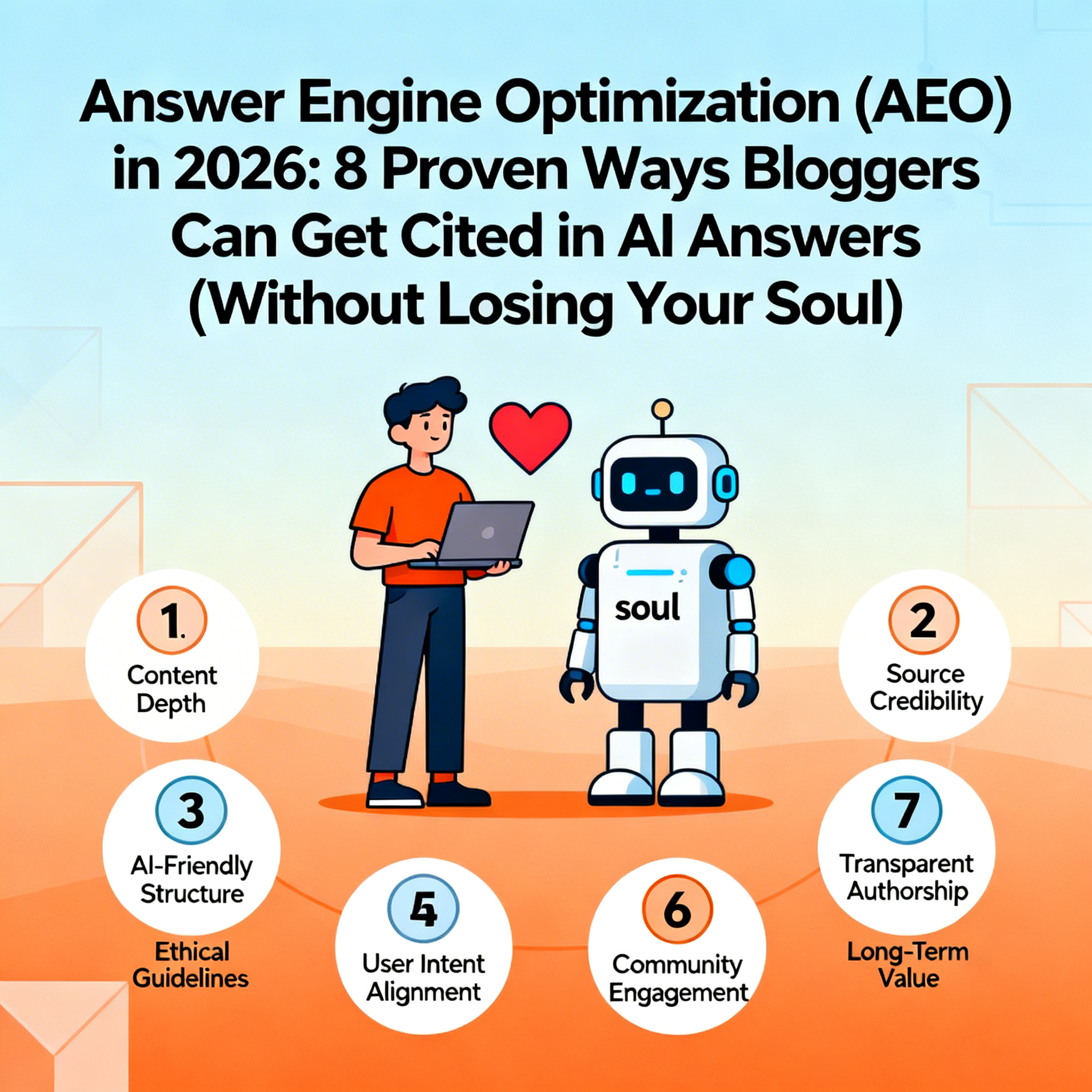
However, you can still achieve strong visibility. The key lies in Answer Engine Optimization—also known as Generative Engine Optimization (GEO) or AI visibility strategies. This approach focuses on getting your content cited or referenced in those AI responses. When your blog becomes the trusted source that AI selects and links to, you gain authority, brand exposure, and qualified traffic from users who click through.
Therefore, this guide shares 8 proven, practical tactics that bloggers use right now to boost citations in 2026. Moreover, these tactics build directly on avoiding common AI content pitfalls (such as generic outputs or missing human touch) while emphasizing authenticity—no soul-selling required.
What Is Answer Engine Optimization (AEO) & Why It Matters More Than SEO Now
Traditional SEO optimizes for rankings on search results pages, so it aims for clicks from positions 1-10. In contrast, Answer Engine Optimization shifts the goal: you make your content the one that AI engines select, extract from, and cite when they generate answers.
Here are the key differences in 2026:
- SEO targets Google and Bing clicks through keywords, backlinks, and site speed.
- AEO targets AI citations in zero-click or low-click environments, such as Google AI Overviews, ChatGPT responses, and Perplexity answers.
Additionally, AI engines rely on retrieval-augmented generation (RAG). They pull relevant passages from indexed sources and prioritize trustworthiness, recency, clear structure, and authority. Why should bloggers care? Platforms like ChatGPT (with hundreds of millions of users) and Perplexity frequently cite sources that do not match top Google results. In fact, fewer than 10% of cited sources in some AI responses align with top-10 organic rankings (HubSpot trends report). Therefore, if you skip AEO optimization, you risk becoming invisible precisely where discovery happens most.
The 8 Proven AEO Tactics for Bloggers in 2026
Here are battle-tested ways to increase your citation chances. These draw from emerging trends, platform behaviors, and real-world patterns.
1. Structure Content for Easy AI Extraction
First, AI favors scannable and parseable formats. Dense paragraphs often get ignored, whereas clear structures help AI pull content easily.
- Use descriptive H2/H3 headings phrased as questions (for example, “What is AEO in 2026?”).
- Start sections with concise answers (120-150 characters TL;DR or direct response).
- Add numbered or bulleted lists, tables for comparisons, and bold definitions.
- Implement schema markup (such as FAQPage, HowTo, or Article) so AI understands context quickly.
As a result, you achieve higher extractability—AI grabs your exact phrasing for summaries (Semrush AI search guide).
2. Inject Real Experience & First-Hand Proof
Next, AI prioritizes E-E-A-T (Experience, Expertise, Authoritativeness, Trustworthiness) even more strongly now. Generic content loses ground, while personal and original insights win citations.
- Share your own experiments (for instance, “I tested AEO on 5 posts—here’s the citation lift”).
- Include unique angles, case studies, or blogger-specific stories.
- Use screenshots, original data, or timestamps to demonstrate recency and authenticity.
3. Answer Ultra-Specific, Long-Tail Questions First
Moreover, AI excels with precise queries. Broad topics receive summaries from many sources, but niche ones earn deep citations from specialists.
- Target conversational long-tails like “how to optimize blog for Perplexity citations 2026” instead of just “AEO tips”.
- Build dedicated “answer pages” around fan-out queries (AI-rewritten prompts).
- Use tools like AlsoAsked or AnswerThePublic to discover real questions.
4. Build Authority Signals AI Trusts
Furthermore, citations favor entities with strong signals, including backlinks, brand mentions, and consistent presence.
- Earn links from reputable sites through guest posts or collaborations.
- Get mentioned across platforms (Reddit, X, forums) to reinforce your entity.
- Maintain consistent branding, bios, and about pages that showcase expertise.
5. Optimize for Citation Fluency & Verifiability
In addition, make your content quotable with an authoritative tone, solid stats, and clear sources.
- Cite data with links (for example, “ChatGPT weekly users doubled to 800M+ in 2025”).
- Incorporate statistics (+37% visibility boost in some studies for data-heavy content).
- Write fluently with clear, natural language rather than keyword-stuffed text.
6. Add Multimedia & Interactive Elements
Similarly, pure text serves as a baseline, but visuals help AI understand and cite richer content.
- Embed images, infographics, or polls with descriptive alt text.
- Use tables for tool comparisons or step-by-step visuals.
- Include embedded code snippets or interactive demos when relevant.
7. Use Human-in-the-Loop AI Workflows
Meanwhile, pure AI drafts often get flagged as low-quality. Instead, blend tools with heavy editing.
- Research and draft with Claude or Gemini, then rewrite in your unique voice.
- Add personal insights, humor, or blogger perspective.
- Fact-check rigorously because AI hallucinations damage trust.
For more on avoiding AI pitfalls, check out our earlier guide: 7 Common AI Content Mistakes Bloggers Make (And Fixes for 2026).
8. Track & Iterate with Answer Engine Optimization Tools
Finally, you cannot improve what you do not measure.
- Use emerging tools to track AI visibility (citation monitoring across models).
- Query your topics in ChatGPT or Perplexity regularly and note the sources.
- Refresh content for recency—update dates and add fresh 2026 insights.
Quick Wins: 3 Things You Can Do Today
- Add a TL;DR summary at the top of your next post.
- Turn one H2 into a direct question with a bold, concise answer below.
- Add FAQ schema to a high-value article and test citations.
Common Answer Engine Optimization Pitfalls to Avoid
- Over-relying on AI without editing (this ties back to generic outputs).
- Ignoring structure or schema—AI cannot extract what it cannot parse.
- Chasing volume over quality—thin content rarely earns citations.
- Neglecting recency—outdated posts drop off quickly.
To build a stronger foundation, explore our Human-First SEO Framework 2026 for blending AI tools with authentic strategies.
Conclusion
To sum up, Answer Engine Optimization is not about gaming AI. Instead, it focuses on creating content so valuable and clear that AI naturally chooses it as the source. In 2026, bloggers who adapt successfully win citations, authority, and sustainable visibility beyond traditional clicks.
Therefore, start small: pick one post, apply 2-3 tactics, and monitor results. The landscape evolves quickly, but these foundations remain solid. For deeper dives into fast WordPress builds optimized for modern search or SaaS prototyping for content workflows, explore Nexum Networks services or subscribe for more tactical guides. Your next citation could be just one optimized post away.
Until next time—keep building!
The Nexum Team